
Driveway drainage problems happen when rain and snowmelt can’t run off the asphalt properly. Water collects in low spots, flows toward the garage or soaks into the base. The usual causes are too little slope, downspouts emptying onto the pavement, settled sections and blocked edges where water has nowhere to go.
For homeowners in Mahwah and nearby Bergen County towns, wet springs and winter freeze-thaw cycles make drainage one of the biggest factors in how long a driveway lasts. Here’s how to spot drainage trouble early, what usually causes it and which options can help.
Key Takeaways
- Standing water, puddles that last for days and ice patches in the same spot every winter are early warning signs.
- Paved surfaces near a home should slope away from the foundation so water drains toward the yard or street.
- Redirecting downspouts away from the driveway is one of the simplest changes you can make.
- Low spots, sunken areas and cracked edges often need repair or regrading, not just a coat of sealer.
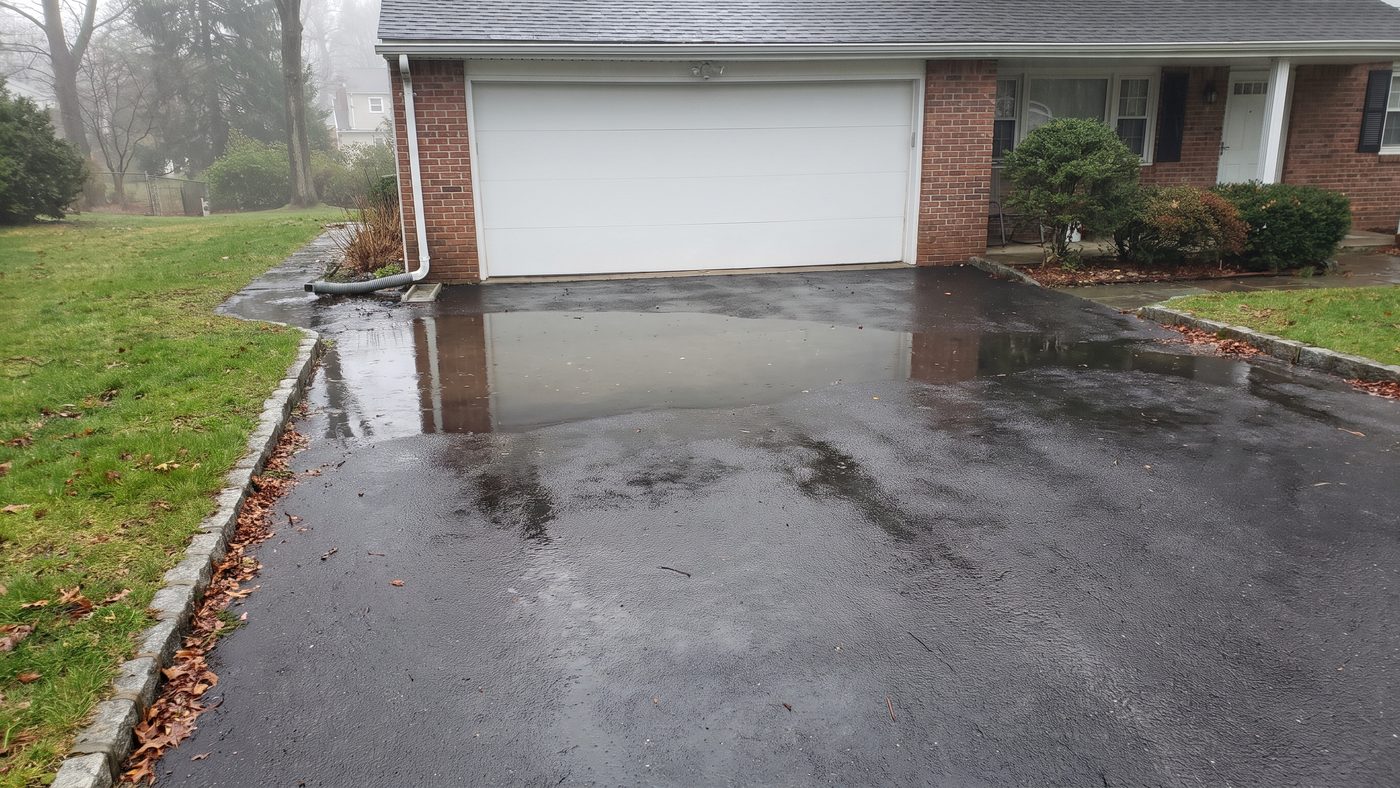
What Are the Signs of Driveway Drainage Problems?
The clearest sign is water that stays on the driveway long after the rain stops. A few other clues are worth watching for:
- Puddles, also called birdbaths, in the same spots after every storm
- Water flowing toward the garage door, front steps or foundation
- Ice sheets forming in one area every winter
- Washed-out gravel, soil or mulch along the driveway edges
- Cracks, soft spots or potholes that keep returning in low areas
- Dark staining or moss where water lingers
The best time to look is during or right after a heavy rain. Walk the driveway and note where water collects and which way it flows. Photos help when you talk with a paving contractor later.
Why Is Standing Water Bad for an Asphalt Driveway?
Standing water is bad for asphalt because it eventually finds its way into cracks and down into the base. When the stone and soil under the pavement stay wet, they lose strength, and the surface above starts to crack, sink and break apart under the weight of cars.
Winter adds pressure. Water that seeps into small cracks freezes, expands and pushes the cracks wider. After a few freeze-thaw cycles, a hairline crack in a wet low spot can turn into a pothole. That’s why drainage problems tend to show up first as repeated damage in the same place.
What Causes Poor Driveway Drainage?
Most drainage problems trace back to slope, water sources or changes in the ground over time.
- Not enough slope. The Wisconsin Asphalt Pavement Association’s Asphalt Parking Lot Design Guide recommends a slope between 2 and 5 percent for paved lots and notes that grades flatter than 2 percent are prone to ponding and birdbaths. The same idea applies to a home driveway: water needs a clear downhill path.
- Slope toward the house. The U.S. Department of Energy’s Building America Solution Center says driveways and other hard surfaces within 10 feet of a home should slope away from the foundation at a 2 percent grade, with drains or swales where that isn’t possible.
- Downspouts. The U.S. EPA notes on its Soak Up the Rain downspout page that downspouts are often aimed at paved surfaces such as driveways, sending water straight across them.
- Settling. Over the years, soft spots in the base can sink, creating dips that hold water.
- Blocked edges. Built-up soil, landscaping or snow piles along the edges can trap water on the pavement.
How Can You Fix Driveway Drainage Problems?
The right fix depends on what’s causing the water to collect. Options range from simple changes you can make yourself to repair work:
- Redirect downspouts. The EPA suggests directing downspout water to a lawn, garden or rain barrel where it can soak in, instead of onto pavement. Check local rules and make sure the water won’t flow toward your foundation or a neighbor’s property.
- Clear the edges. Pull back soil and mulch that sits higher than the asphalt so water can run off.
- Seal cracks. Sealing cracks before winter helps keep water out of the base.
- Patch or raise low spots. Sunken areas can often be cut out, rebuilt and repaved so water no longer pools.
- Add a drain or swale. Where the slope can’t be changed, a trench drain at the garage or a shallow grassy swale along the side can carry water away.
- Regrade and resurface. If the whole driveway pitches the wrong way, resurfacing or rebuilding with the right slope may be the long-term answer.
Should You Repair or Replace a Driveway With Drainage Problems?
Repair usually makes sense when the problem is limited to a few low spots or one section, and the rest of the driveway is solid. Replacement or a full rebuild is worth considering when water damage has spread across much of the surface, the base is soft in several places or the driveway was built with the wrong pitch from the start.
A paving contractor can check the slope with a level, look at how the edges and downspouts are handling water and tell you which approach fits the condition of your driveway.
How All Around Asphalt Can Help
All Around Asphalt helps Mahwah homeowners find out where water is coming from and why it’s collecting. The team can patch low spots, seal cracks, rebuild damaged sections and resurface driveways with a proper pitch, so water runs off instead of soaking in. Learn more about our asphalt repair services in Mahwah, NJ.
Frequently Asked Questions
How much slope does a driveway need to drain?
Guidance for paved surfaces near homes calls for about a 2 percent slope away from the house, roughly a quarter inch per foot. Your contractor will check what’s practical for your lot.
Can sealcoating fix drainage problems?
No. Sealcoating protects the surface, but it won’t change the slope or raise low spots. Drainage problems need repair, regrading or a drain.
Is a puddle after a storm always a problem?
A small puddle that dries within a few hours usually isn’t serious. Water that sits for a day or more, or keeps getting bigger, is worth having checked.
When is the best time to repair driveway drainage problems?
Paving work is usually done in warmer months. Fall is a good time to have the driveway looked at and to seal cracks before freeze-thaw season.
Why does ice always form in the same spot on my driveway?
Repeated ice in one area usually means water is collecting there or flowing across it, often from a downspout or a low spot.
Noticing puddles or ice in the same spots on your driveway? Call All Around Asphalt at 862-283-9101 to have it looked at.