
Professional asphalt contractors extend your pavement’s life by implementing science-backed solutions to combat deterioration. They’ll apply commercial-grade sealants that penetrate deeper than DIY options, properly repair potholes by addressing subsurface issues, and install strategic drainage systems to prevent water damage. Their preventative maintenance plans deliver a 10:1 cost-benefit ratio compared to replacement, while advanced rejuvenation treatments restore flexibility to aging surfaces. Understanding these specialized techniques reveals why professional intervention dramatically outperforms stopgap measures.
Key Asphalt Repair Strategies to Prolong Pavement LifespanKey Takeaways
- Professional contractors use specialized crack sealing techniques that can extend asphalt longevity by up to 300%.
- Experts implement proper drainage solutions including strategic slopes and catch basins to prevent water damage.
- Contractors apply protective treatments that shield pavement from UV radiation, water infiltration, and chemical spills.
- Skilled professionals perform timely pothole repairs with proper excavation and compaction to prevent structural failures.
- Asphalt rejuvenation treatments restore essential oils to aging pavement, extending service life by 5-7 years.
The Science Behind Asphalt Deterioration
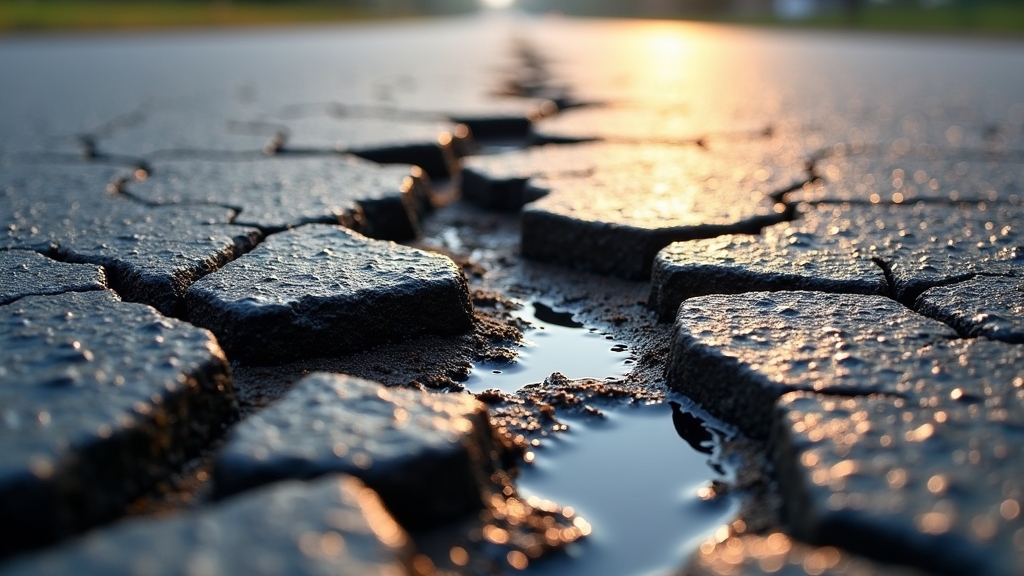
While asphalt pavements are designed for durability, they inevitably deteriorate through a complex interaction of environmental factors and mechanical stresses. Understanding this process helps you appreciate why professional repair is essential.
Asphalt composition consists primarily of aggregate (crushed stone and sand) bound together by bitumen, a petroleum-based adhesive. This structure begins to weaken when ultraviolet radiation from sunlight oxidizes the bitumen, causing it to lose flexibility and develop microcracks.
Water then infiltrates these cracks, expanding during freeze-thaw cycles and accelerating deterioration. Additional environmental factors like chemical exposure from automotive fluids and deicing salts further break down the binding properties.
The mechanical stress from vehicles—particularly heavy trucks—compounds this damage, creating fatigue cracking, rutting, and eventually potholes. Heat fluctuations cause thermal expansion and contraction, weakening structural integrity over time.
Heavy traffic accelerates asphalt failure through cracking and rutting, while temperature changes gradually compromise the pavement’s structure.
This deterioration accelerates exponentially without intervention, which is why timely maintenance by qualified contractors is vital.
Expert Damage Assessment: Beyond What’s Visible
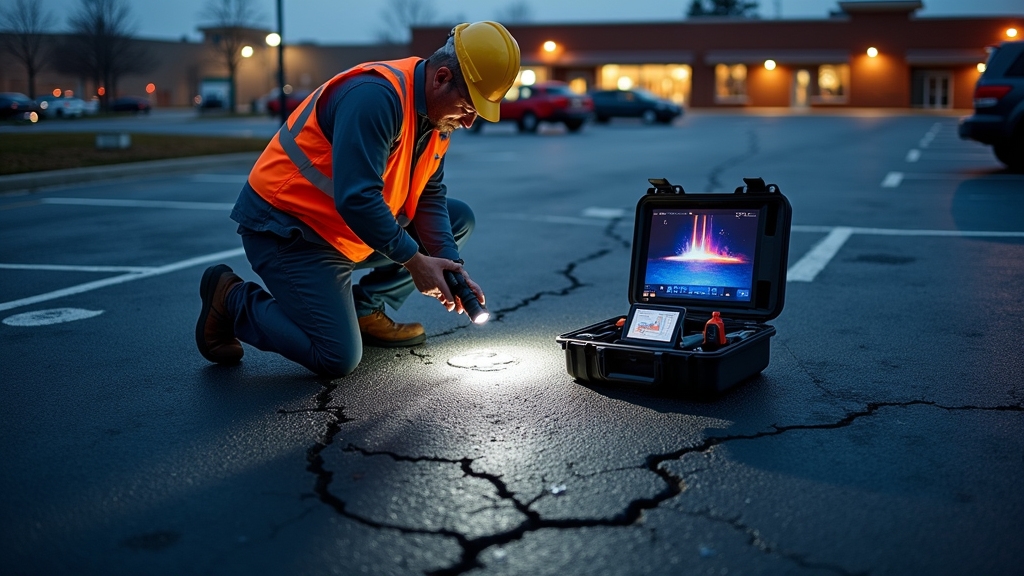
When experienced asphalt repair contractors evaluate your pavement, they’re conducting assessments that extend far beyond surface-level observations. Their visual inspection reveals immediate concerns like cracks and potholes, but professionals also identify hidden damage that untrained eyes would miss.
Using specialized equipment, contractors can detect subsurface water infiltration, base layer compromise, and structural weaknesses before they manifest visibly. They’ll analyze drainage patterns, assess load-bearing capacity, and evaluate aggregate separation within the asphalt matrix.
Your contractor will systematically document temperature-related expansion damage, chemical erosion from fuel spills, and UV degradation patterns. They’ll measure crack depth rather than just surface width, determine if water has penetrated to sublayers, and identify whether damage originated from top-down pressure or bottom-up failure.
This thorough assessment enables contractors to develop targeted repair strategies that address root causes rather than merely patching visible symptoms, ultimately extending your pavement’s functional lifespan considerably.
Crack Sealing Techniques That Actually Work
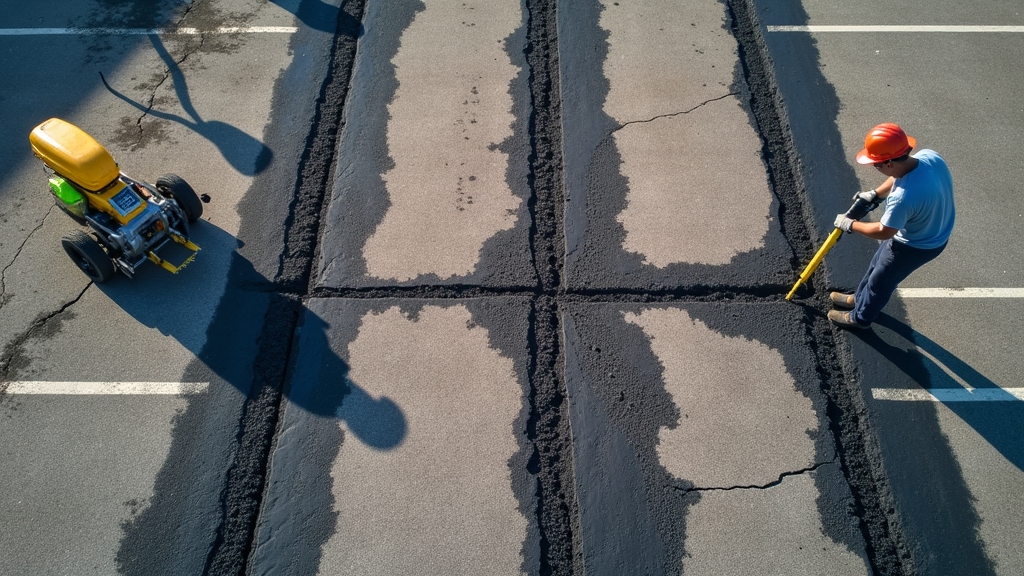
Three primary crack sealing techniques deliver demonstrable longevity when properly implemented by qualified contractors.
Timely crack sealing prevents water infiltration—the primary catalyst for pavement deterioration—extending asphalt longevity by up to 300% when executed correctly.
The effectiveness of your crack sealing depends on method selection, material quality, and application precision:
- Hot-applied thermoplastic sealants – Heated to 370°F, these polymer-modified compounds create thermal bonds with crack walls, accommodating 25-50% movement while maintaining adhesion through freeze-thaw cycles.
- Cold-applied emulsions – Utilized for hairline cracks under 1/8″, these specialized latex-modified solutions penetrate deeper than hot applications, creating flexibility barriers in early-stage deterioration.
- Mastic applications – Combining aggregates with binding agents to fill wider cracks (>2″), creating structural reinforcement rather than merely sealing surface openings.
Don’t confuse DIY crack filling with professional crack sealing—the former addresses aesthetics while the latter delivers infrastructure preservation.
Pothole Repair Methods for Lasting Results
Pothole repair represents a more significant structural challenge than crack sealing, requiring specialized methodologies that address both surface and sub-base integrity.
Professional contractors typically employ three primary pothole patching techniques: hot mix asphalt, cold patch applications, and infrared restoration.
When you’re seeking lasting results, the repair process must include proper excavation to remove all compromised material. Contractors will square off the damaged area, apply a tack coat for adhesion, and then compact the new material in layers. This methodical approach prevents water infiltration and subsequent failure.
Your preventive maintenance strategies should incorporate routine inspections to identify developing potholes before they expand. Early intervention dramatically reduces repair costs and extends pavement life.
For high-traffic areas, consider semi-permanent or permanent repair methods rather than temporary fixes. These approaches may cost more initially but deliver superior durability and performance over time, ultimately providing better value through reduced frequency of repairs.
Professional-Grade Materials vs. Store-Bought Solutions
Why do professional contractors consistently achieve superior asphalt repair results? The answer lies in the quality of materials they use.
Professional-grade asphalt mixtures contain specialized polymers and binding agents that store-bought solutions simply can’t match. These materials are formulated for specific climate conditions and traffic loads, ensuring longevity that DIY products can’t deliver.
Store bought limitations become evident within months of application, as these products often lack proper adhesion properties and temperature resilience.
Professional advantages extend beyond just better materials:
- Hot-mix asphalt maintained at precisely 275-300°F during application, creating molecular bonds that resist water penetration and freeze-thaw damage
- Industrial-grade emulsifiers that allow repairs to bond completely with existing pavement, eliminating separation points
- UV-stabilized sealants that prevent oxidation and extend repair lifespan by 300% compared to consumer products
You’re investing in durability when choosing contractor-grade materials over temporary fixes.
Water Drainage Solutions to Prevent Future Damage
Water drainage solutions represent critical infrastructure for preserving your asphalt investment against moisture-related deterioration.
You’ll need to contemplate French drain installation for redirecting groundwater away from pavement foundations, properly engineered sloped pavement designs that prevent water pooling, and strategic catch basin systems to collect and channel runoff during heavy precipitation events.
These preventative drainage measures work together as an integrated system to extend your pavement’s service life by eliminating the primary catalyst for asphalt failure—standing water.
French Drain Installation
Proper drainage represents the cornerstone of long-term asphalt preservation, with French drains offering an exceptional solution for redirecting excess moisture away from your pavement.
These subsurface drainage systems provide substantial drainage benefits by collecting water before it can undermine your asphalt’s foundation. The installation process requires precision and expertise that professional contractors deliver consistently.
- Contractors excavate a trench along the problem area, sloping it to direct water away from your asphalt surface.
- A perforated pipe wrapped in geotextile fabric is positioned within a gravel-filled trench, creating ideal water collection points.
- The completed system operates silently beneath the surface, constantly protecting your pavement’s structural integrity.
You’ll notice immediate improvements during heavy rainfall as water diverts through your French drain rather than pooling on your asphalt surface.
Sloped Pavement Design
Strategic slope integration within asphalt surfaces represents one of the most effective preventative measures against water-related deterioration. You’ll find properly designed sloped pavements direct water away from the surface, preventing pooling that leads to erosion and base weakening.
| Slope Percentage | Drainage Efficiency | Application Areas |
| 1-2% | Moderate | Parking lots, walkways |
| 2-4% | Good | Driveways, minor roads |
| 4-6% | Excellent | Highway shoulders |
| >6% | Superior | Steep terrain, channels |
Your pavement’s longevity depends on this critical design element. Contractors analyze your property’s topography to determine ideal slope directions, creating strategic crowns or cross-slopes that channel water toward designated collection points. These sloped pavement benefits include reduced freeze-thaw damage, decreased material degradation, and minimized repair frequency—ultimately saving you significant maintenance costs over your pavement’s lifespan.
Catch Basin Systems
Effective catch basin systems form the backbone of extensive asphalt drainage infrastructure, collecting and redirecting surface water away from paved areas.
Professional contractors implement strategic catch basin design to prevent water pooling that deteriorates your pavement’s foundation and accelerates deterioration.
Your catch basin maintenance schedule should include:
- Quarterly debris removal from grates and sumps to prevent blockages that lead to flooding and pavement undermining.
- Annual inspection of basin walls and connections to identify structural compromises before they cause sinkholes.
- Biennial assessment of water flow patterns to guarantee ideal drainage gradient and prevent erosion around pavement edges.
When properly maintained, these drainage solutions greatly extend your asphalt’s service life by eliminating standing water—the primary catalyst for premature failure and costly repairs.
Contractors can retrofit existing systems or design new installations based on your site’s specific topography.
Seasonal Maintenance Strategies for Different Climates
Seasonal asphalt maintenance requires specific strategies tailored to your region’s climate conditions for maximum pavement longevity.
You’ll need winter freeze protection methods such as crack sealing before freezing temperatures arrive, summer heat safeguards including reflective sealcoating, and rainy season drainage solutions that prevent water accumulation on the surface.
Implementing these climate-specific approaches systematically throughout the year will greatly reduce repair costs and extend your asphalt’s serviceable lifespan.
Winter Freeze Protection Methods
When winter temperatures plummet below freezing, asphalt surfaces become particularly vulnerable to damage from freeze-thaw cycles and deicing chemicals.
Professional contractors employ specialized winter insulation techniques to shield your pavement from these harsh conditions.
To maximize freeze resistance and extend your pavement’s lifespan, contractors implement these protective measures:
- Application of penetrating sealants that create a waterproof barrier, preventing moisture infiltration that leads to cracking when frozen.
- Installation of proper drainage solutions to divert water away from pavement surfaces, reducing ice formation potential.
- Utilization of fiber-reinforced winterized patching materials specifically formulated to maintain flexibility at sub-freezing temperatures.
These proactive protection methods greatly reduce winter damage, ultimately saving you costly repairs and preserving your pavement’s structural integrity through the harshest months of the year.
Summer Heat Safeguards
While winter’s freezing temperatures present one set of challenges, summer’s extreme heat creates equally destructive forces on asphalt surfaces. Asphalt becomes pliable at temperatures exceeding 120°F, making it susceptible to rutting and deformation under vehicle weight. Professional contractors implement strategic heat reflection techniques and pavement cooling strategies to mitigate damage.
| Protection Method | Benefit | Implementation Timeline |
| Seal Coating | Creates UV barrier, prevents oxidation | Every 2-3 years |
| Light-Colored Additives | Reduces heat absorption by 10-15% | During installation/resurfacing |
| Micro-Surfacing | Reflects solar radiation, prevents softening | Every 5-7 years |
You’ll find these protective measures particularly essential for high-traffic areas and southern regions where surface temperatures can exceed 170°F. Properly timed applications guarantee your pavement maintains structural integrity throughout extreme summer conditions.
Rainy Season Drainage Solutions
Proper drainage serves as the cornerstone of asphalt longevity during prolonged precipitation periods.
When you contract professional asphalt repair specialists, they’ll implement thorough rainwater management strategies that prevent water infiltration and subsequent deterioration of your pavement’s structural integrity.
Your contractor will assess your property’s unique topography to design an effective drainage system that diverts water away from vulnerable areas:
- Installation of French drains alongside pavement edges to capture and redirect surface runoff
- Strategic placement of catch basins at low points to prevent water pooling that leads to asphalt deterioration
- Implementation of cross-slope grading techniques that maintain a 1-2% slope for ideal water shedding capabilities
These drainage solutions don’t merely address current water issues but provide preventative protection that greatly extends your pavement’s functional lifespan.
Cost Analysis: Timely Repairs vs. Complete Replacement
Because asphalt deteriorates at an accelerating rate once damage begins, understanding the cost implications of repair timing is essential for property managers.
Small cracks that cost $1-3 per linear foot to seal can expand into potholes requiring $8-15 per square foot to patch. Delaying these timely repairs often leads to base failure, where complete replacement costs surge to $25-45 per square foot.
Preventative maintenance isn’t merely optional – it’s the difference between manageable $3 repairs and devastating $45 reconstruction costs.
The financial equation is straightforward: investing $2,500 in preventative maintenance today prevents a $25,000 reconstruction project tomorrow. This 10:1 cost-benefit ratio doesn’t account for additional factors like business disruption, liability concerns, and aesthetic degradation.
Your maintenance strategy should follow the 70% rule: when repair costs exceed 70% of replacement costs, full reconstruction becomes more economical.
Professional contractors can provide detailed cost analysis that factors in your pavement’s condition, usage patterns, and climate exposure, ensuring you’re making financially sound decisions for your property’s specific circumstances.
Advanced Rejuvenation Treatments for Aging Pavement
Modern asphalt rejuvenation leverages emulsion penetration methods that restore essential oils to your aging pavement, extending its service life by up to 5-7 years.
You’ll find these specialized emulsions penetrate 3/8 to 1/2 inch into the pavement surface, reactivating the oxidized binder and improving flexibility in deteriorating asphalt.
Polymeric surface sealants complement these treatments by creating a protective barrier against UV radiation, water infiltration, and chemical spills—forming a molecular bond that prevents further oxidation while enhancing the pavement’s resistance to thermal cracking.
Emulsion Penetration Methods
While traditional patch repairs address surface damage, emulsion penetration methods target the molecular structure of aging asphalt pavements to restore flexibility and extend service life.
These specialized treatments involve applying carefully formulated emulsions that penetrate deep into microcracks and voids, rejuvenating the oxidized binder.
Your contractor will select from various emulsion types based on your pavement’s specific condition:
- Cationic emulsions – positively charged particles that bond aggressively with negatively charged aggregate surfaces, ideal for humid climates
- Polymer-modified emulsions – containing elastomeric additives that enhance flexibility and crack resistance in temperature-fluctuating environments
- Rejuvenating emulsions – formulated with maltene replacers that restore the asphalt’s original chemical composition
Advanced penetration techniques include high-pressure injection systems, vacuum-assisted saturation, and timed application sequences that maximize vertical migration through the pavement profile.
You’ll notice improved resilience immediately following treatment.
Polymeric Surface Sealants
As your asphalt pavement ages and oxidation compromises its structural integrity, polymeric surface sealants offer a sophisticated alternative to conventional preservation methods.
These advanced formulations penetrate the top layers of your asphalt, forming a protective barrier against UV rays, water infiltration, and chemical exposure.
Unlike standard sealants, polymeric treatments contain engineered molecules that create flexible, durable bonds with the existing pavement structure.
You’ll notice immediate polymeric benefits, including enhanced resistance to fuel spills and deicing chemicals. The molecular structure reestablishes lost flexibility in aged binder, preventing micro-cracking during thermal cycling.
Professional contractors apply these sealants in precise quantities—typically 0.10-0.15 gallons per square yard—ensuring ideal surface longevity.
With proper application, you can expect 3-5 additional years of service life beyond conventional treatments.
How to Select the Right Asphalt Contractor for Your Property
Selecting the ideal asphalt contractor for your property requires thorough research and careful evaluation of multiple factors. You’ll need to verify contractor qualifications, including proper licensing, insurance coverage, and industry certifications that demonstrate technical expertise in asphalt installation and repair methodologies.
Thorough contractor vetting ensures optimal asphalt installation through verified credentials and demonstrated technical expertise.
Request detailed project timelines from each potential contractor, ensuring they can accommodate your schedule while allowing sufficient time for proper material curing and settlement processes. Experienced contractors will provide extensive documentation of their anticipated workflow phases.
When evaluating potential asphalt contractors, focus on:
- Portfolio assessment – Examine their previous projects similar to yours, inspecting the edge definition, drainage slope calculations, and surface uniformity.
- Equipment inventory – Verify they possess modern pavers, rollers, and milling machines calibrated for precision application.
- Material specifications – Request detailed asphalt mix designs appropriate for your climate zone and anticipated load requirements.
Don’t hesitate to request references from property managers with similar pavement dimensions and usage patterns.
Frequently Asked Questions
1. How do professional asphalt contractors extend the life of my pavement?
Experienced contractors use advanced repair and preservation methods—such as hot-applied crack sealing, pothole reconstruction, and asphalt rejuvenation treatments—to slow aging and prevent deeper structural failure. These methods address root causes like drainage, oxidation, and base weakness, not just surface damage.
2. What’s the difference between DIY asphalt repair and professional service?
DIY repair kits only fill surface cracks temporarily, while professional contractors use industrial-grade materials and equipment that penetrate deep into the asphalt layers. Hot-mix asphalt and polymer-modified sealants form thermal and molecular bonds that resist water infiltration and UV damage, offering up to 300% longer performance than store-bought products.
3. How do contractors know when my pavement needs repair or replacement?
Professionals conduct comprehensive inspections using moisture sensors, infrared imaging, and core sampling to assess sub-base integrity. If damage is confined to the surface or top layers, targeted repairs are sufficient. When base or drainage failure is detected, contractors recommend section reconstruction or full resurfacing.
4. Why is proper drainage so important for asphalt preservation?
Standing water is asphalt’s biggest enemy—it seeps into microcracks, freezes, and expands, breaking apart the pavement from within. Professional contractors design sloped surfaces, French drains, and catch basins to divert water away from the asphalt base, preventing erosion and extending lifespan by several years.
5. How often should I schedule asphalt maintenance?
Routine maintenance, including crack sealing every 12–18 months and sealcoating every 2–3 years, provides continuous protection. High-traffic commercial areas or regions with extreme weather may require more frequent service. Scheduled preventive maintenance typically offers a 10:1 cost-benefit ratio compared to reactive repairs.
6. What are asphalt rejuvenation treatments, and when should they be applied?
Rejuvenation treatments use emulsion penetration technology to restore essential oils and flexibility lost through oxidation. They’re ideal for pavements aged 5–10 years that show early signs of brittleness or minor surface cracking. When applied correctly, rejuvenators can extend pavement life by 5–7 years.
7. How do contractors repair potholes to ensure long-lasting results?
Professional repairs involve excavating the damaged area, cleaning debris, applying a tack coat, and compacting hot-mix asphalt in layers. This method restores the sub-base and prevents future water intrusion. Infrared patching and semi-permanent repairs also provide excellent durability for high-traffic areas.
8. Can professional asphalt contractors help reduce future repair costs?
Yes. By addressing small issues before they escalate, contractors help prevent large-scale deterioration. Regular crack sealing, drainage improvements, and surface protection can cut lifetime repair costs by 30–40% while minimizing downtime for commercial properties.
9. What are the signs my pavement needs professional attention?
You should call a contractor if you notice:
- Multiple or widening cracks
- Standing water after rain
- Uneven or soft spots underfoot
- Faded color or oxidation
- Potholes reappearing after patching
These indicate structural stress that only a professional can properly diagnose and treat.
10. How can All Around Asphalt help extend my pavement’s lifespan?
At All Around Asphalt, we combine decades of field experience with industry-leading technology to deliver long-term pavement protection. Our licensed professionals specialize in:
- Crack and pothole repair
- Drainage system installation
- Rejuvenation and sealcoating treatments
- Preventive maintenance programs customized to your site
Final Thoughts
Professional asphalt repair isn’t a cosmetic quick-fix—it’s a science-driven strategy that interrupts deterioration, restores flexibility, and prevents water-related failures before they escalate. By pairing precise crack sealing, true sub-base pothole reconstruction, drainage improvements, and targeted rejuvenation treatments, you’ll extend pavement life years beyond what DIY products can deliver—often with a 10:1 cost benefit over replacement.
If you want results that last, partner with specialists who address root causes, not just symptoms. AtAll Around Asphalt, our licensed crews deliverasphalt repair,sealcoating, andasphalt resurfacing programs engineered for your traffic, climate, and budget. We’ll assess drainage, specify the right materials, and build a proactive plan to maximize service life and minimize lifecycle costs.
Ready to add years to your pavement? Call862-283-9101 or request a free assessment via ourcontact page. Prefer a full refresh? We also handleparking lot paving with durable, high-visibility results that look great and perform even better.